TECHACS Safety Solutions | Person Protective Equipment (PPE)| PPE Suppliers

TECHACS Safety Solutions | Person Protective Equipment (PPE)| PPE Suppliers
Working in low light conditions in proximity to moving vehicles or machinery is one of the most common causes of workplace accidents.
Incidents involving vehicles and machinery and low light conditions occur across a wide range of industries including agriculture, transportation, construction and vehicle repair.
Injuries suffered include amputations, dislocations, complex fractures and worse. The consequences are catastrophic for individuals affected.
EN343 is the European standard that applies to garments worn in adverse weather conditions. This standard specifies requirements and test methods applicable to the materials and seams of protective clothing against the influence of precipitation (e.g. rain, snowflakes), fog and ground humidity.
EN342 is the European standard that applies to garments worn in cold environments. This standard specifies requirements and test methods for the performance of clothing ensembles (i.e two-piece suits/coveralls) for protection against the effects of cold environments equal to or below -5°C (23°F).
HIGH VISIBILITY GARMENT TYPES are designated by the work environment in which the wearer is performing a task.
There are 3 types as shown on the table below – TYPE 0, TYPE R AND TYPE P.
PERFORMANCE CLASSES provide a range of design options corresponding with the needs of the user in the expected risk environment.
CLASS 1 (TYPE 0) is worn in non-complex work areas in which vehicles will not be moving at roadway speeds.
CLASS 2 (TYPE R OR P) uses more high visibility material than Class 1 which allows the HVSA to define the human more effectively.
CLASS 1 (TYPE 0) is worn in non-complex work areas in which vehicles will not be moving at roadway speeds.
CLASS 2 (TYPE R OR P) uses more high visibility material than Class 1 which allows the HVSA to define the human more effectively.
These symbols indicate that the garment is tested and is compliant with ANSI/ISEA -107, the American National Standard for High Visibility Safety Apparel and Headwear. Each symbol denotes the garment type and the performance class associated with each garment.
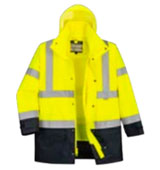
Must incorporate a minimum of 1240 in2 of background material and 310 in2 of retroreflective materials.
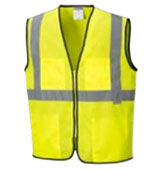
Must incorporate a minimum of 775 in2 of background material and 201 in2 of retroreflective materials.
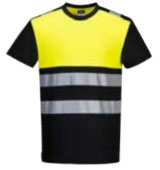
Must incorporate a minimum of 217 in2 of background material and 155 in2 of retroreflective materials.
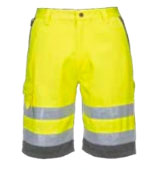
Must incorporate a minimum of 465 in2 of background material and 109 in2 of retroreflective materials.
| Garment Type | Performance Class | Background Material | Retroreflective or Combined-Performance Materials | Minimum Width Reflective Material |
|---|---|---|---|---|
| Type 0 Off-road and Non-Roadway Use | Class 1 | 217 in2 (0.14m2) | 155 in2 (0.10m2) | 1in. (25mm) |
| Type R Roadway and Temporary Traffic Control Zones | Class 2* | 775 in2 (0.50m2) | 201 in2 (0.13m2) | 1in. (25mm) 1.68in. (35mm) |
| Class 3** | 1240 in2 (0.80m2) | 310 in2 (0.20m2) | 1in. (25mm) 2in. (50mm) | |
| Type P Emergency and Incident Responders and Law Enforcement Personnel | Class 2 | 450 in2 (0.29m2) | 201 in2 (0.13m2) | 1in. (25mm) 2in. (50mm) |
| Class 3 | 775 in2 (0.50m2) | 310 in2 (0.20m2) | 1in. (25mm) 2in. (50mm) | |
| Supplemental Items | Class E | 465 in2 (0.30m2) | 109 in2 (0.07m2) | 1in. (25mm) 2in. (50mm) |
*For the smallest size in Type R. Class 2, a minimum of 0.35 m’ (540 in’) of background material may be used to accommodate small-sized workers. All subsequent larger sizes must use 0.50 m? (775 in’).
**For the smallest size in Type R, Class 3, a minimum of 0.65 m’ (1000 in’) of background material may be used to accommodate small-sized workers. All subsequent larger sizes must use 0.80 m’ (1240 in’).