When it comes to workplace safety, hard hats are a crucial element in protecting your head from potential hazards. However, to maximize your protection, it’s essential to choose the right accessories for your hard hat. Whether you’re working on a construction site or in an industrial setting, understanding the various hard hat accessories and their compatibility is key to maintaining safety standards and comfort. Let’s explore the different accessories available and how they can enhance the functionality of your hard hat.
View product compatibility chart ↓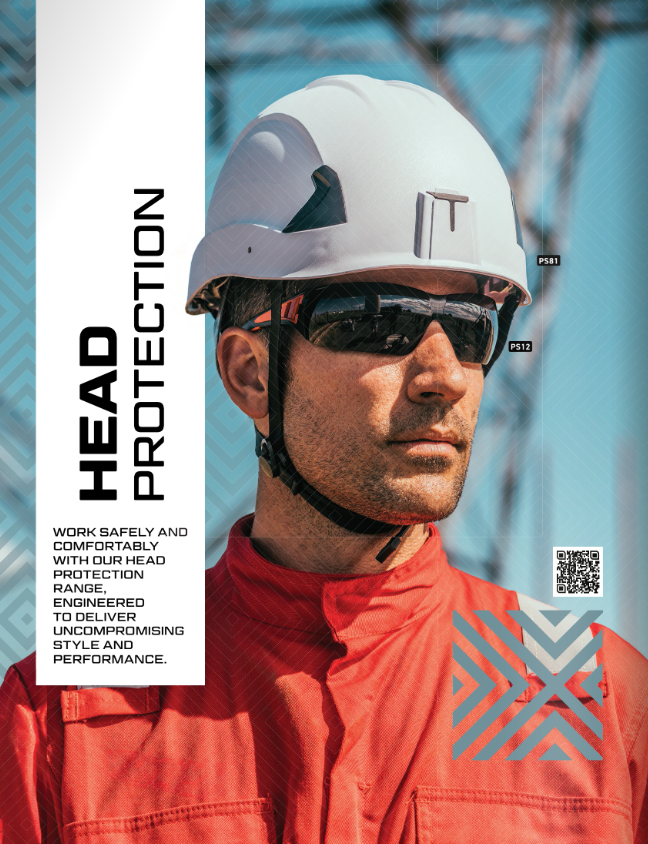
Essential Hard Hat Accessories
- 2-Point Chin Strap
A chin strap is essential for keeping your hard hat secure, especially when working in environments with high winds or where the risk of the hard hat falling off is higher. The 2-point chin strap is an excellent option for ensuring your hat stays in place. - Sweatband
Comfort is just as important as safety. A sweatband helps absorb sweat, keeping your forehead dry and preventing sweat from dripping into your eyes. It also contributes to maintaining hygiene and comfort during long hours of work. - Visor Carrier
Protect your face and eyes with a visor carrier. These carriers securely hold visors or eye shields, providing full-face protection from flying debris, dust, or harmful chemicals. - Visor / Eye-Shield
The visor or eye-shield provides protection for your eyes and face from flying particles, UV rays, and other environmental hazards. This accessory is especially important for those working in areas with high debris or where sharp objects are in motion. - Clip-on Ear Muff
For environments with high noise levels, adding ear protection is a must. Clip-on ear muffs can easily be attached to your hard hat to provide hearing protection, reducing the risk of hearing loss from prolonged exposure to loud noises.
Choosing the Right Hard Hat
Selecting the right hard hat depends on the nature of the work and specific safety requirements. Below are some common types of hard hats, classified by their design, impact type, and electrical resistance.
Impact Type:
- Type I: Designed to protect against impacts to the top of the head.
- Type II: Provides protection from impacts to both the top and sides of the head.
Electrical Protection:
- Class G (General): Designed for protection from low-voltage conductors (tested at 2,200 volts).
- Class E (Electrical): Designed for protection against higher voltage conductors (tested at 20,000 volts).
- Class C (Conductive): Provides no electrical protection.
Additional Features:
- Reverse Donning: Hard hats that can be worn frontward or backward while maintaining compliance with testing requirements.
- Lower Temperature (LT): Hard hats that remain compliant at temperatures as low as -22°F (-30°C).
- High Visibility (HV): Meets testing requirements for high visibility colors to ensure workers are visible in low-light environments.
- Higher Temperature (HT): Compliant with testing standards at temperatures up to 140°F (60°C).
Hard Hat Marking and Standards
When choosing a hard hat, always look for the appropriate marking and classification to ensure it meets required safety standards. Below are some essential standards you should be aware of:
- ANSI/ISEA Z89.1: The American National Standard for Industrial Head Protection, updated in 2014, outlines the performance and testing criteria for hard hats.
- EN 397:2012: The European Standard for Industrial Safety Helmets that includes mandatory tests for impact resistance, flammability, and penetration. Optional tests may include extreme temperature resistance and electrical properties.
Hard hats are designed to reduce the risk of head injury from falling objects, electrical hazards, and other workplace dangers. OSHA regulations mandate the use of appropriate hard hats for workers in hazardous conditions.
Conclusion
Choosing the right hard hat and accessories can make a significant difference in workplace safety. Understanding the various features and classifications of hard hats and their accessories allows you to make an informed decision that aligns with your work environment and safety needs. Whether you need enhanced visibility, electrical protection, or additional comfort, selecting the right gear will ensure your head protection is always at its best.
At TechACS, we provide high-quality hard hats and accessories to meet the needs of various industries. As an Authorized Portwest Dealer, we offer a wide range of solutions to keep you safe on the job.
For more information on selecting the right hard hat and accessories, contact us today!
View the original hard hat reference chart
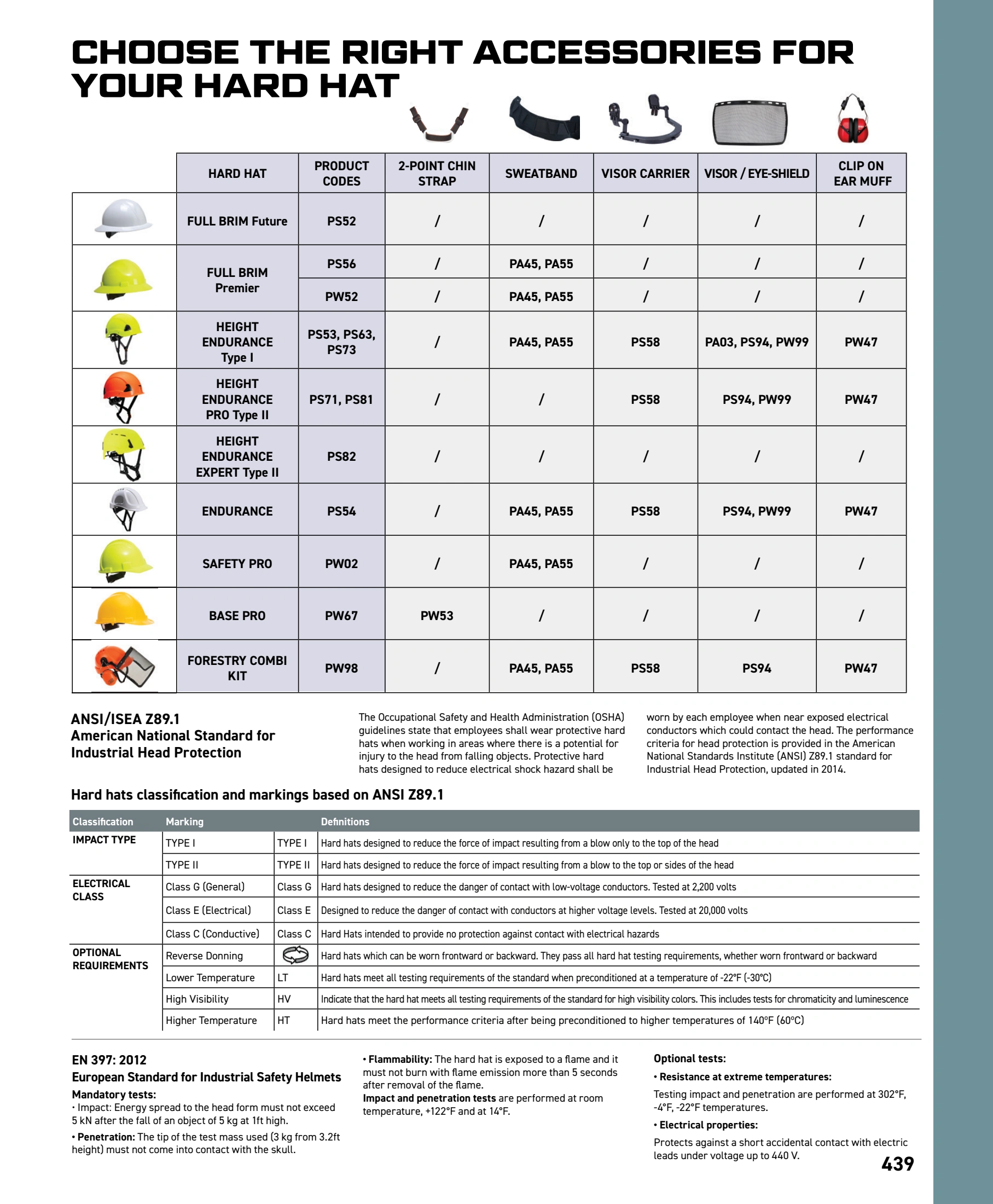
Hard hat accessory compatibility and standards reference
The following tables and notes reproduce the text in the original reference chart above, including its cited standards editions. A slash (/) is retained wherever it appears in the original chart.
| HARD HAT | PRODUCT CODES | 2-POINT CHIN STRAP | SWEATBAND | VISOR CARRIER | VISOR / EYE-SHIELD | CLIP ON EAR MUFF |
|---|---|---|---|---|---|---|
| FULL BRIM Future | PS52 | / | / | / | / | / |
| FULL BRIM Premier | PS56 | / | PA45, PA55 | / | / | / |
| FULL BRIM Premier | PW52 | / | PA45, PA55 | / | / | / |
| HEIGHT ENDURANCE Type I | PS53, PS63, PS73 | / | PA45, PA55 | PS58 | PA03, PS94, PW99 | PW47 |
| HEIGHT ENDURANCE PRO Type II | PS71, PS81 | / | / | PS58 | PS94, PW99 | PW47 |
| HEIGHT ENDURANCE EXPERT Type II | PS82 | / | / | / | / | / |
| ENDURANCE | PS54 | / | PA45, PA55 | PS58 | PS94, PW99 | PW47 |
| SAFETY PRO | PW02 | / | PA45, PA55 | / | / | / |
| BASE PRO | PW67 | PW53 | / | / | / | / |
| FORESTRY COMBI KIT | PW98 | / | PA45, PA55 | PS58 | PS94 | PW47 |
ANSI/ISEA Z89.1
American National Standard for Industrial Head Protection
The Occupational Safety and Health Administration (OSHA) guidelines state that employees shall wear protective hard hats when working in areas where there is a potential for injury to the head from falling objects. Protective hard hats designed to reduce electrical shock hazard shall be worn by each employee when near exposed electrical conductors which could contact the head. The performance criteria for head protection is provided in the American National Standards Institute (ANSI) Z89.1 standard for Industrial Head Protection, updated in 2014.
Hard hats classification and markings based on ANSI Z89.1
| Classification | Marking | Symbol or code | Definitions |
|---|---|---|---|
| IMPACT TYPE | TYPE I | TYPE I | Hard hats designed to reduce the force of impact resulting from a blow only to the top of the head |
| IMPACT TYPE | TYPE II | TYPE II | Hard hats designed to reduce the force of impact resulting from a blow to the top or sides of the head |
| ELECTRICAL CLASS | Class G (General) | Class G | Hard hats designed to reduce the danger of contact with low-voltage conductors. Tested at 2,200 volts |
| ELECTRICAL CLASS | Class E (Electrical) | Class E | Designed to reduce the danger of contact with conductors at higher voltage levels. Tested at 20,000 volts |
| ELECTRICAL CLASS | Class C (Conductive) | Class C | Hats intended to provide no protection against contact with electrical hazards |
| OPTIONAL REQUIREMENTS | Reverse Donning | [Reverse donning symbol] | Hard hats which can be worn frontward or backward. They pass all hard hat testing requirements, whether worn frontward or backward |
| OPTIONAL REQUIREMENTS | Lower Temperature | LT | Hard hats meet all testing requirements of the standard when preconditioned at a temperature of -22°F (-30°C) |
| OPTIONAL REQUIREMENTS | High Visibility | HV | Indicate that the hard hat meets all testing requirements of the standard for high visibility colors. This includes tests for chromaticity and luminescence |
| OPTIONAL REQUIREMENTS | Higher Temperature | HT | Hard hats meet the performance criteria after being preconditioned to higher temperatures of 140°F (60°C) |
EN 397: 2012 European Standard for Industrial Safety Helmets
Mandatory tests: Impact: Energy spread to the head form must not exceed 5 kN after the fall of an object of 5 kg at 1ft high. Penetration: The tip of the test mass used (3 kg from 3.2ft height) must not come into contact with the skull. Flammability: The hard hat is exposed to a flame and it must not burn with flame emission more than 5 seconds after removal of the flame. Impact and penetration tests are performed at room temperature, +122°F and at 14°F.
Optional tests: Resistance at extreme temperatures: Testing impact and penetration are performed at 302°F, -4°F, -22°F temperatures. Electrical properties: Protects against a short accidental contact with electric leads under voltage up to 440 V.